
Xiamen Mellow Rotomolding, dedicated on rotomolding /rotational moulded R&D manufacture, is located at beautiful coastal city Xiamen.



Xiamen Mellow Rotomolding, dedicated on rotomolding /rotational moulded R&D manufacture, is located at beautiful coastal city Xiamen.

The global boat console market was valued at $6.15 billion in 2025 and is projected to reach $9.31 billion by 2032, growing at a CAGR of 6.1%. Within that market, pontoon boats hold a 24.7% share—approximately $0.77 billion—and are expected to post the fastest growth through 2030, driven by family-oriented recreational demand.
That growth is reshaping how OEMs and boat builders think about console sourcing. A pontoon helm console is not merely a mounting surface for gauges and a steering wheel. It is a structural component that must withstand continuous UV exposure, saltwater spray, vibration from outboard motors, and the daily wear of an open-air cockpit. Traditional fiberglass consoles—while aesthetically familiar—are increasingly being replaced by rotomolded polyethylene (PE) alternatives for reasons that go beyond cost.
This guide breaks down what rotomolded pontoon consoles are, what materials are commonly used for pontoon boat consoles, how rotomolded PE compares with fiberglass and aluminum, and how to evaluate an OEM manufacturer for your next console program.
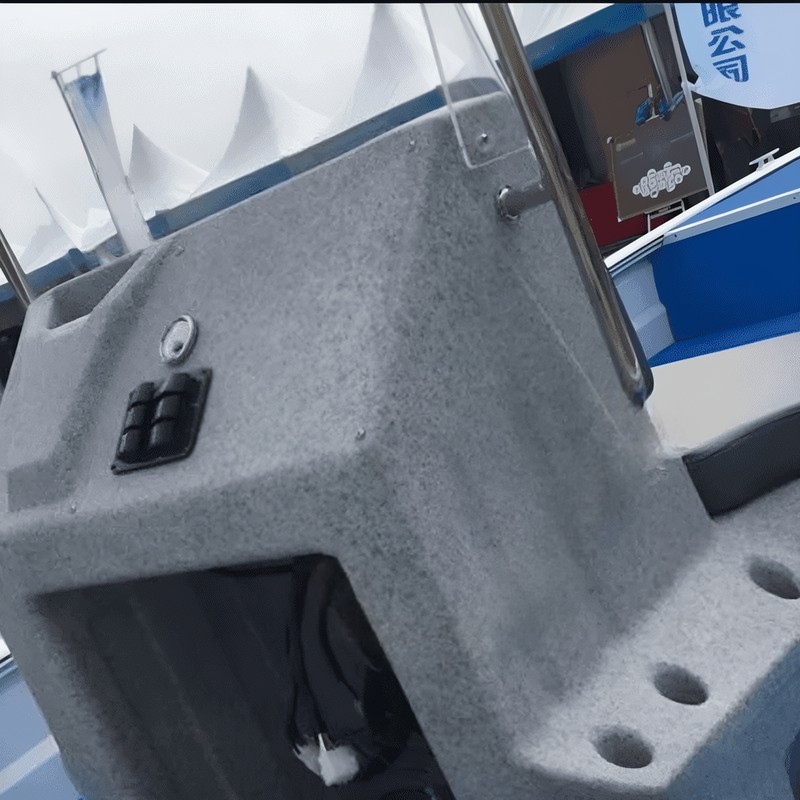
A rotomolded pontoon console is a seamless, hollow structural component manufactured through rotational molding—a heated, multi-axis rotation process in which powdered polyethylene resin melts and evenly coats the inner walls of an aluminum mold. Unlike injection molding or blow molding, rotomolding operates without external pressure, producing stress-free walls with uniform thickness across complex geometries.
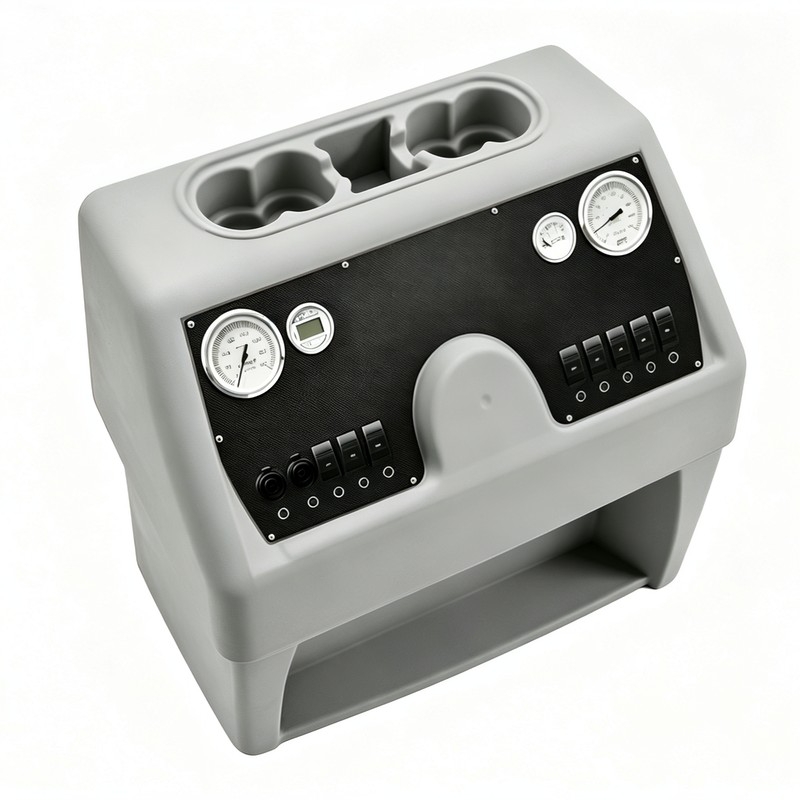
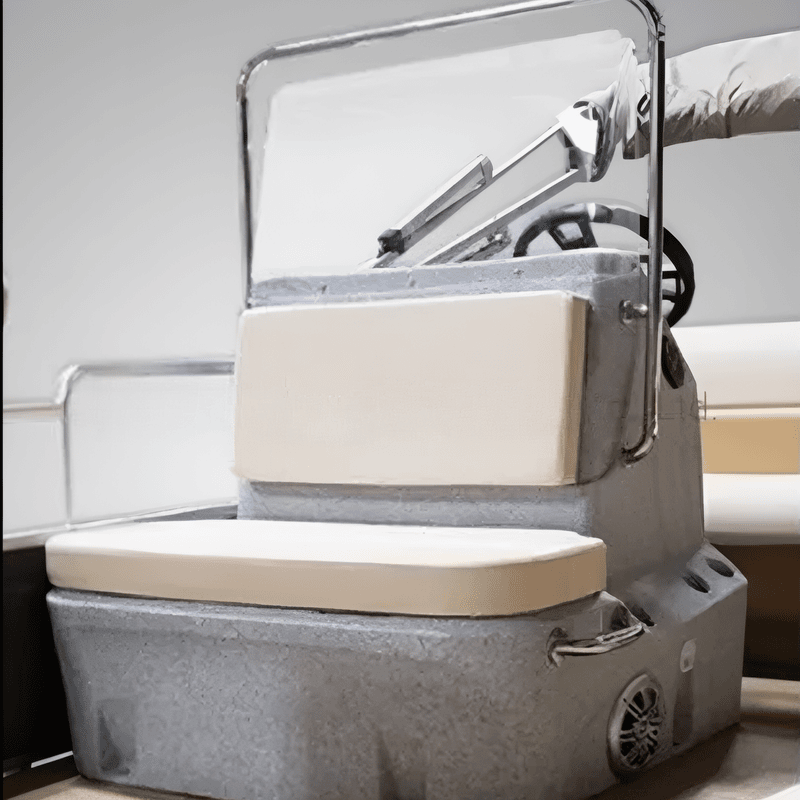
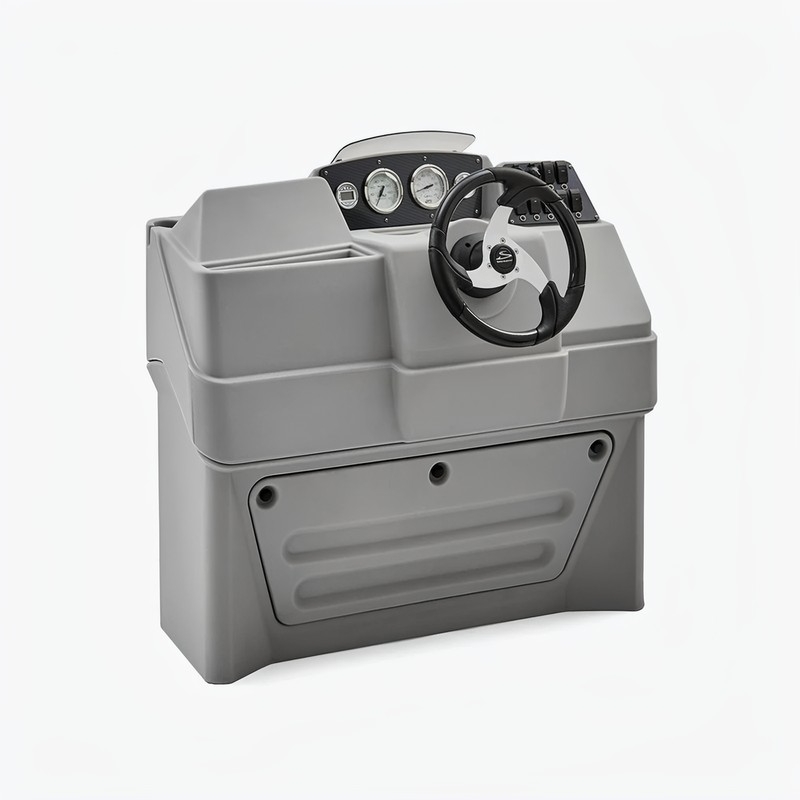
This process is particularly advantageous for pontoon boat applications. Modern pontoon boat helm consoles feature sculpted dash panels, integrated storage compartments, recessed mounting bosses for gauges and switches, and built-in wire routing channels. Rotomolding can consolidate all of these features into a single molded part, eliminating secondary assembly steps and potential leak paths.
Pontoon boat consoles are not made from a single material. Different boat builders choose different solutions based on model positioning, cost, appearance requirements, and production volume:
Fiberglass (FRP): Currently the most common material for pontoon boat consoles. Fiberglass consoles offer design freedom and a high-gloss gelcoat finish, and are widely used in mid-to-high-end pontoon boats. However, fiberglass is brittle and may develop gelcoat blistering and spider cracking under prolonged vibration and saltwater exposure, and repair is relatively difficult.
Aluminum: Aluminum consoles do exist, typically using all-welded construction. They are lightweight and strong, suitable for pontoon boats requiring weight reduction or an industrial style. Aluminum requires coating protection and attention to galvanic corrosion between stainless steel components.
Injection-molded plastics: Injection-molded plastics exist, but they are mainly used for small console components such as door panels, trim pieces, mounting brackets, and instrument housings. Injection molding is suitable for small, high-precision, high-volume parts, not for large hollow console bodies.
Wood: Wood is mainly used for local decoration or instrument panels on consoles, such as teak or mahogany panels or steering wheel bases. After preservative treatment, it offers some weather resistance, but it is no longer a mainstream structural material in modern pontoon boat consoles.
Rotomolded polyethylene (PE): Rotomolded PE is an emerging console material in recent years, suitable for large hollow, feature-integrated, and high-impact structural parts. It can be made into a seamless hollow console and directly mold in instrument mounting points, storage compartments, wire routing channels, and more.
Conclusion: The mainstream structural materials for pontoon boat consoles are fiberglass and aluminum; injection molding is used for small accessories; wood is used for decorative panels; rotomolded PE is an emerging solution that balances impact resistance, corrosion resistance, and functional integration.
| Feature | Rotomolded PE | Fiberglass (FRP) | Aluminum |
| Corrosion Resistance | 100% rustproof; inert to saltwater | Resistant, but gelcoat degrades | Requires coating; galvanic corrosion risk |
| Impact Resistance & Durability | Absorbs impact and rebounds; does not become brittle at low temperatures; rarely damaged | Brittle; cracks under vibration | Permanently dents |
| Color Depth | Through-color (will not fade to white) | Gelcoat surface only | Painted surface only |
| Mold Cost | Low to moderate (aluminum mold) | Low mold cost, high labor | Moderate to high |
| Design Complexity | High—organic curves, undercuts, molded-in inserts | Moderate—limited by layup | Low—geometric limitations |
| Weight | Light | Moderate | Moderate to heavy |
| Repair After Damage | Linear PE can be heat-welded; cross-linked PE is not weldable | Delamination risk; difficult to repair | Weldable |
| Optimal Production Volume | Small to mid-high volume (OEM) | Low to mid volume | Variable |
The performance gap is most obvious in three areas: impact resistance, durability, and color longevity. Although fiberglass consoles are smooth and polished when new, they are prone to spider cracking around stress points, gelcoat blistering under prolonged saltwater exposure, and are difficult to repair once cracked. Polyethylene consoles, by contrast, absorb impact without cracking, remain tough even in sub-zero extreme temperatures, and rarely suffer structural damage in daily use. The core advantage of rotomolded PE is not that it is "easy to repair," but that it "doesn't break easily." If a linear PE component develops a crack, it can be repaired by hot-air welding, whereas cross-linked PE is not weldable. In addition, PE consoles maintain their molded-in color throughout the material thickness, with no gelcoat to chip or fade.
The through-color advantage is not trivial for pontoon boats, which often operate in high-UV environments. Fiberglass and painted aluminum consoles require periodic refinishing as their surface finishes degrade. UV-resistant PE consoles maintain their appearance without maintenance intervention.
That said, fiberglass still has an advantage in one area: surface finish. Rotomolded consoles have a slightly textured, matte appearance by default. For manufacturers requiring a high-gloss, premium appearance, additional post-processing may be necessary, such as in-mold surface texturing or secondary painting. This is a design consideration, not a limitation.
Material Grade and UV Stabilization
Not all polyethylene is created equal. For marine console applications, the resin must incorporate sufficient UV stabilization additives to prevent degradation, fading, and structural fatigue from prolonged sun exposure. Marine-grade rotomolding polyethylene resin formulations are specifically stress-relieved and UV-stabilized for harsh marine environments, and are impervious to salt and moisture. Confirm that the manufacturer specifies virgin resin with a documented UV additive package—not regrind or recycled material.
Wall Thickness and Structural Design
Molded - In Insert Integration
One of rotomolding's strongest advantages is encapsulating inserts directly into the console wall during molding. Threaded brass inserts for instrument mounting, aluminum flanges for steering bezels, pre-drilled holes for switch panels, and ventilation openings can all be integrated directly into the mold design, minimizing secondary assembly steps. This reduces labor costs and eliminates potential leak paths associated with post-molding drilling.
Environmental and Temperature Tolerance
Pontoon boats operate across a wide temperature range. Confirm that the selected PE formulation maintains flexibility and impact toughness in sub-zero freezing temperatures and high-temperature environments. Linear low-density polyethylene (LLDPE) is the standard choice for marine components because it retains high impact toughness in extreme cold, preventing cold-shatter cracking under impact.
The rotomolding industry has a wide range of capabilities. Some suppliers specialize in high-volume commodity parts; others are equipped for complex, feature-dense OEM console programs. Here are the evaluation criteria that matter most:
In - House Mold Engineering
Material Traceability and Certification
Feature Integration Capability
Production Volume Flexibility
Lead Time Transparency
A well-structured rotomolded console program follows a clear sequence:
Step 1: Design Review and DFM Analysis. The manufacturer evaluates your STEP/IGS files for rotational molding feasibility—wall thickness distribution, draft angles, mold parting lines, and feature placement.
Step 2: Mold Design and Fabrication. Aluminum molds are machined from the approved 3D model. Complex consoles may require multi-piece molds with removable sections for undercuts.
Step 3: Prototype and Validation. First-article samples are produced, measured for wall thickness uniformity, and tested for fit and finish. This is the point to verify instrument mounting positions, steering bezel alignment, and wire routing.
Step 4: Production and Quality Control. Each production batch undergoes dimensional inspection, wall thickness verification, and visual inspection. For marine components, UV testing and impact testing should be included in the quality protocol.
Step 5: Post-Processing and Assembly. Trimming, drilling, insert installation, and surface finishing are completed as required.
 |
 |
 |
 |
Yes. With proper double-walled construction and localized reinforcement at mounting points, rotomolded consoles provide ample structural rigidity. The key is designing the mold with integrated reinforcement ribs and molded-in mounting bosses rather than relying on wall thickness alone.
Rotomolded consoles have a slightly textured, matte finish by default. Through in-mold texturing and surface treatment, the finish can be refined to meet specific aesthetic requirements. The advantage is that the color goes through the entire material, so scratches and wear do not expose a different underlying color.
Custom aluminum mold fabrication typically takes 30–45 days. Prototype samples can be produced and delivered for approval within 7–10 days after mold completion. Production lead time depends on order volume and is quoted on a project basis.
Yes. Custom color matching is available for all rotomolded console programs. UV-resistant pigment is compounded into the resin, ensuring consistent color throughout the part and long-term resistance to fading.
Scan to WhatsApp :

Home
products
contact