
Xiamen Mellow Rotomolding, dedicated on rotomolding /rotational moulded R&D manufacture, is located at beautiful coastal city Xiamen.



Xiamen Mellow Rotomolding, dedicated on rotomolding /rotational moulded R&D manufacture, is located at beautiful coastal city Xiamen.
Selecting the right floating dock cubes is critical for the long-term safety, stability and maintenance costs of marinas, jetties, water parks and commercial floating platforms. Many project managers focus only on price or surface appearance, but the real performance difference often comes down to material quality, molding technology and structural design.Among the many options available, rotomolded floating dock cubes have become a preferred choice for modular marine systems. Unlike simple plastic floats, a rotomolded floating dock cube is a structural buoyancy component that must withstand UV exposure, saltwater corrosion, wave impact, fluctuating water levels and continuous pedestrian loads.
This guide explains how to evaluate rotomolded floating dock cubes from a practical engineering and procurement perspective, so you can choose the most suitable product for your marina or water platform project.

Why rotomolded floating dock cubes are different from traditional flotation products
Traditional floating dock components are often made by bonding, welding or assembling multiple parts. These connection points can create potential weak areas. Over time, water intrusion, cracking and deformation may occur, especially in harsh marine environments.
Rotomolded floating dock cubes are manufactured through a rotational molding process. The mold rotates biaxially in a high-temperature environment, so the molten polyethylene resin is evenly distributed across the inner surface of the mold. This process creates a seamless hollow structure with uniform wall thickness.
This seamless manufacturing method is particularly suitable for marine applications. Because there are no weld lines or bonded joints, rotomolded floating dock cubes can significantly reduce the risk of water penetration. For project owners, this means better long-term durability and lower maintenance costs.
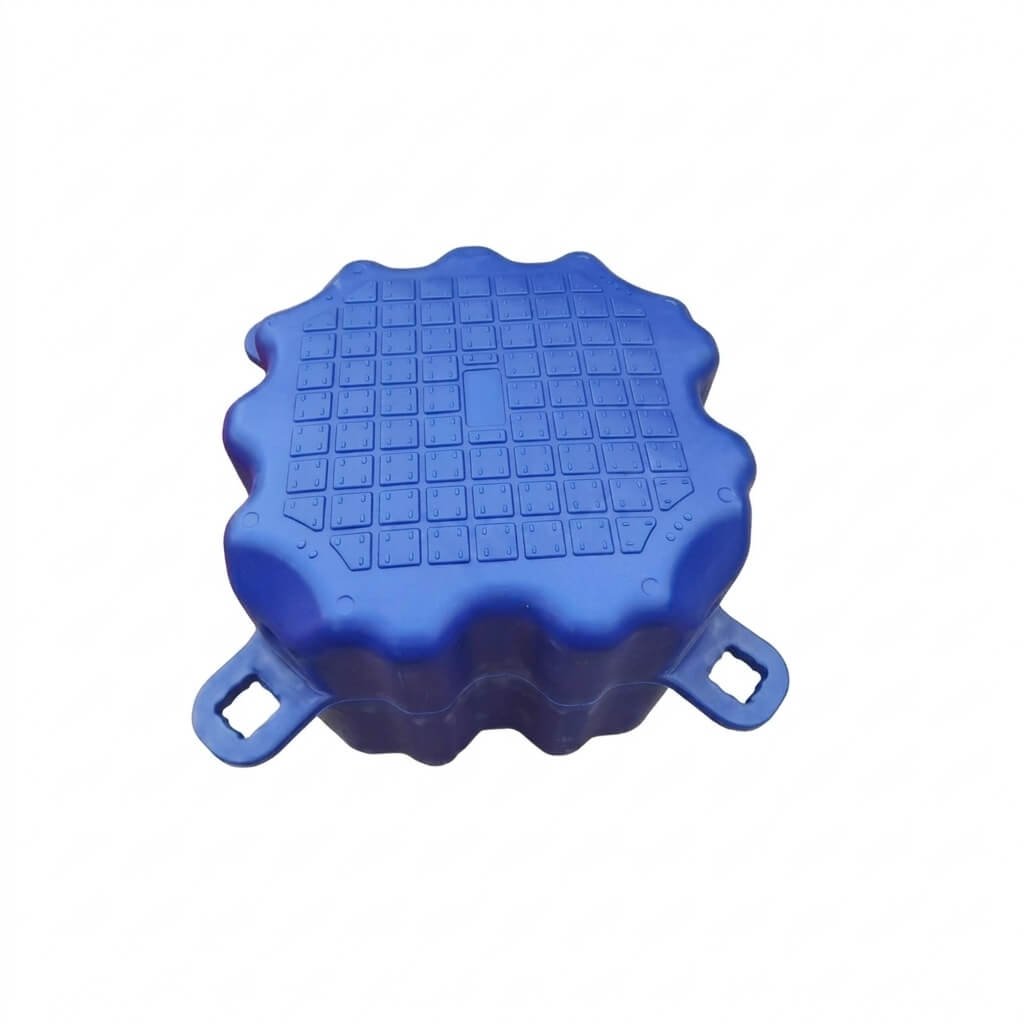
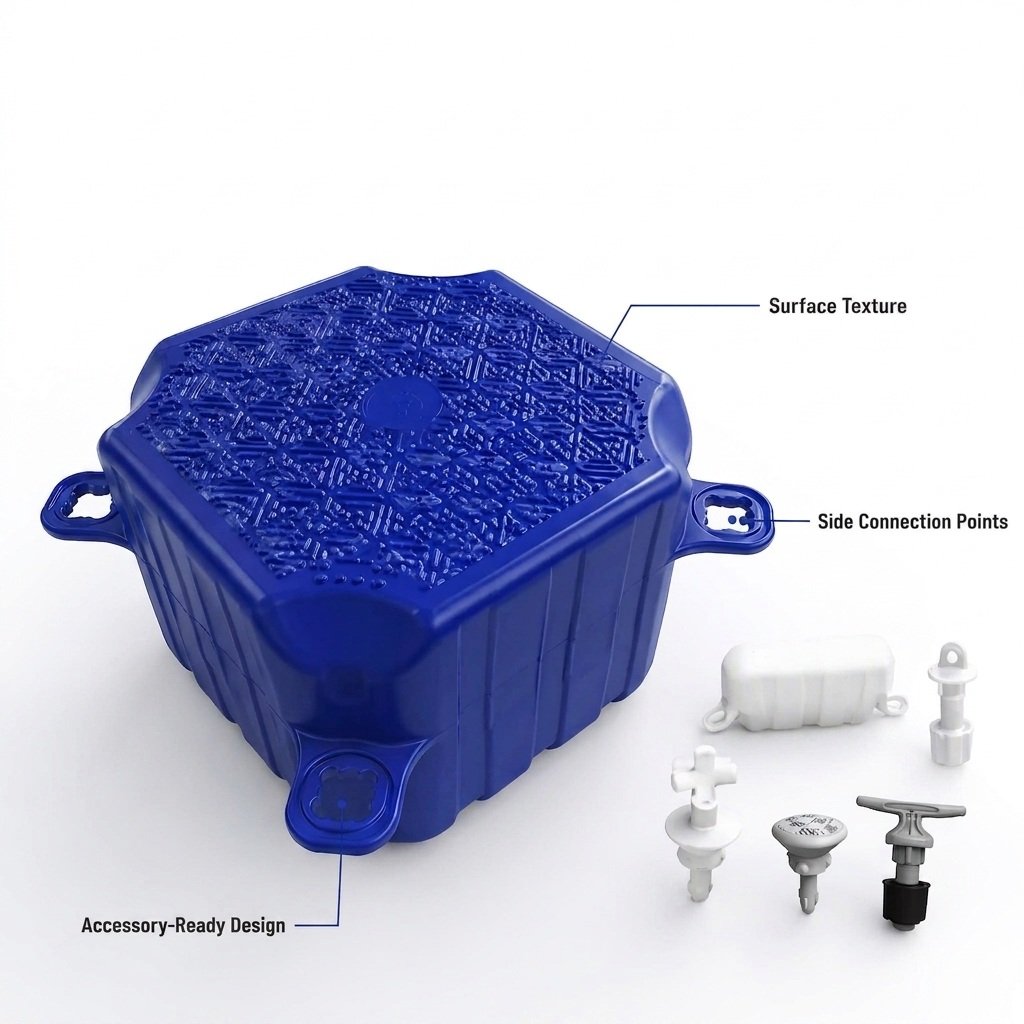
A rotomolded floating dock cube is a hollow structural float block produced by rotational molding. It is usually made from high-density polyethylene, or HDPE, and designed to be interlocked with other units to form larger stable platforms.
Modern rotomolded floating dock cubes often include integrated lugs, slots, mounting points and connection structures. These features are directly formed during the molding process, which reduces secondary machining and assembly work.
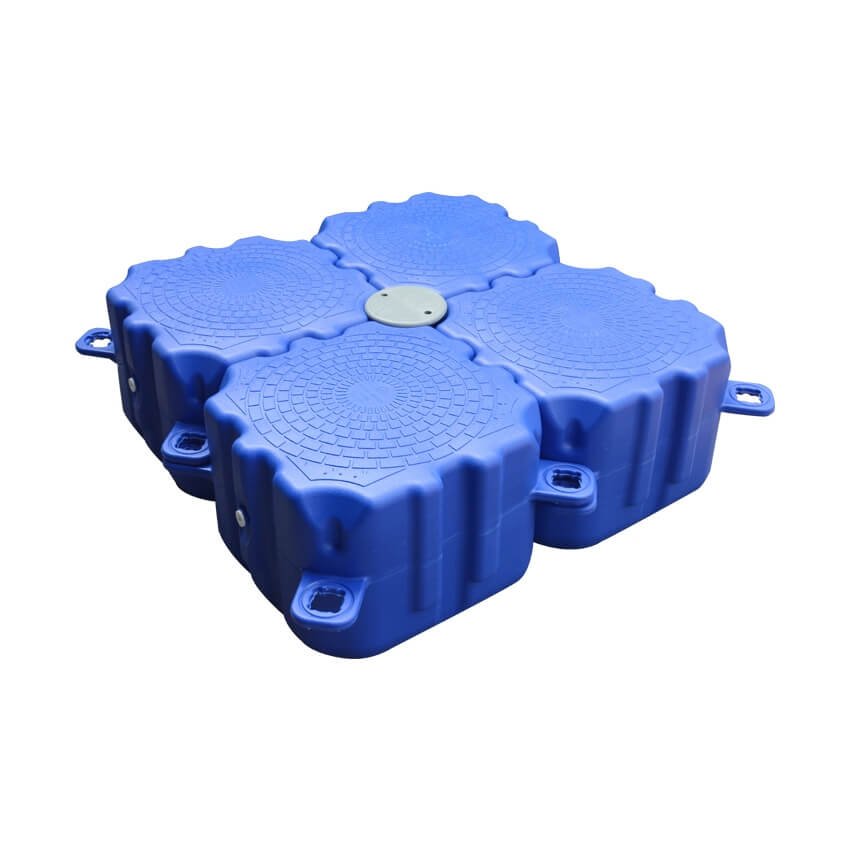
Because each rotomolded floating dock cube works as an independent buoyancy unit, the overall system can be flexibly expanded. Users can add, remove or reconfigure blocks according to project requirements, making it suitable for marinas, temporary work platforms, water park facilities and jetty construction.
What materials are commonly used for floating dock cubes?
Floating dock cubes are not made from a single standard material. The most common options include rotomolded polyethylene, fiberglass, aluminum and wood. Each material has different performance characteristics and suitable scenarios.
Rotomolded polyethylene is currently one of the most widely used materials for modular floating dock cubes. It has excellent corrosion resistance, good impact absorption and relatively low maintenance requirements. Marine-grade HDPE can also be formulated with UV stabilizers for long-term outdoor use.
Fiberglass, or FRP, can provide a smooth surface and good initial rigidity. However, it is relatively brittle. Under repeated impact or vibration, cracks may occur. Once water enters the laminate structure, the buoyancy performance may gradually decline.
Aluminum is lightweight and has high tensile strength, but it is usually more expensive. In saltwater environments, aluminum also requires careful corrosion protection, especially when connected to other metal parts.
Wood has a low upfront cost, but it is not an ideal long-term solution for floating dock systems. It is prone to rot, water absorption and biological fouling, so it requires frequent maintenance.
Rotomolded PE vs Fiberglass vs Aluminum:which is better for marine projects?
When comparing floating dock materials, you should look beyond surface appearance and consider corrosion resistance, impact performance, maintainability and total cost of ownership.
| Material | Corrosion Resistance | Impact Performance | Durability | Maintenance |
| Rotomolded PE | Excellent | Good impact absorption | Long service life | Low |
| Fiberglass | Good, but surface degrades | Brittle, prone to cracking | Medium | Higher repair cost |
| Aluminum | Risk of galvanic corrosion | High rigidity, but may dent | Good if protected | Requires coating and inspection |
Key engineering specifications when selecting rotomolded floating dock cubes
When selecting rotomolded floating dock cubes, many buyers only compare size and price. However, several engineering parameters will directly affect the safety and service life of the entire system.
Not all polyethylene is suitable for marine environments. Rotomolded floating dock cubes for outdoor projects should use UV-stabilized HDPE resin. Long-term sunlight exposure can cause material aging, fading and reduced impact strength, so UV additives are essential.
Wall thickness is directly related to buoyancy, load capacity and durability. Thicker walls generally provide higher structural strength, but the weight and cost will also increase. The key is to achieve a reasonable balance based on the project’s load requirements.
One of the advantages of rotomolded floating dock cubes is that connection lugs and slots can be integrally molded. These structures help transfer loads between blocks and improve the stability of the entire platform.
Floating docks must work in different seasons. The selected material should remain flexible in cold weather and not easily deform under continuous high-temperature exposure in summer.
How to evaluate an OEM manufacturer for rotomolded floating dock cubes
Choosing the right OEM manufacturer is just as important as choosing the right product structure. A high-quality rotomolded floating dock cube depends not only on the material, but also on mold design, process control and quality testing.
Mold design directly affects wall thickness uniformity, part consistency and product durability. Manufacturers with in-house mold engineering capabilities can usually respond faster to design changes and solve structural problems during development.
When purchasing rotomolded floating dock cubes, you should confirm the resin grade, UV stabilization package and batch traceability. Clear material documentation helps ensure consistent quality across production batches.
Reliable manufacturers usually conduct dimensional inspection, visual inspection and leak testing for rotomolded floating dock cubes. For marine projects, vacuum leak testing is especially important to avoid water penetration during service.
Rotational molding is suitable for both small-batch custom projects and mid-volume production. If your project requires special sizes, colors or integrated connection structures, choose an OEM that can support prototype development and gradual scaling.
The OEM customization process:from CAD to production
A well-structured rotomolded custom floating dock project follows a clear workflow:
Frequently Asked Questions
If you need custom rotomolded floating dock cubes, the process usually starts with technical discussion and design review.
The manufacturer will evaluate your CAD files from a rotomolding perspective. This includes wall thickness, draft angles, undercuts, connection structures, buoyancy requirements and material selection.
Once the design is confirmed, the mold will be manufactured. For complex rotomolded floating dock cubes, multi-piece molds may be required to ensure proper material flow and part removal.
After the mold is completed, prototype samples will be produced. These samples can be used to check dimensions, wall thickness, interlocking fit and buoyancy performance before mass production.
During formal production, each batch of rotomolded floating dock cubes should go through dimensional checks, leak testing and visual inspection.
Finally, the products will be trimmed, deburred and packaged. Some projects may also require custom color molding, marking or pre-assembly of connection parts.
Frequently asked questions
Q1:Can rotomolded floating dock cubes be customized? A:Yes. Size, color, wall thickness, connection structure and logo marking can all be customized according to project requirements.
Q2:Are rotomolded floating dock cubes suitable for saltwater? A:Yes. With marine-grade UV-stabilized HDPE, rotomolded floating dock cubes can be used in both saltwater and freshwater environments.
Q3:What is the service life of rotomolded floating dock cubes? A:Under normal marine environment and proper use, high-quality rotomolded floating dock cubes can have a service life of 15–25 years.
Q4:Can I get samples before mass production? A:Yes. Prototype samples are available for structure verification, assembly testing and buoyancy evaluation.
Conclusion
Selecting rotomolded floating dock cubes requires a balance of material performance, structural design, manufacturing quality and total cost of ownership. For marina operators, jetty contractors and water platform developers, rotomolded floating dock cubes offer strong durability, low maintenance and flexible system expansion.
If you are planning a modular floating dock project, it is recommended to evaluate the product from multiple angles:material grade, UV stabilization, wall thickness, interlocking structure, leak testing and OEM engineering capability.
If you would like a technical review or quotation for your floating dock design, please contact Mellow Rotomolding and send us your CAD files or project specifications. Our engineering team will help you select the most suitable rotomolded floating dock cube solution.
Scan to WhatsApp :

Home
products
contact