

|
Rotational molding is valued for producing seamless, stress-free, large hollow parts. Yet one of its most persistent technical challenges remains wall thickness distribution. Unlike injection molding, where pressure fills a fixed cavity, rotomolding builds the wall layer by layer as powdered resin melts and fuses against the heated mold surface. As a result, the process is highly sensitive to powder properties, mold design, oven conditions, rotation ratios, and cooling. |

The Physical Principles behind Wall Thickness Formation
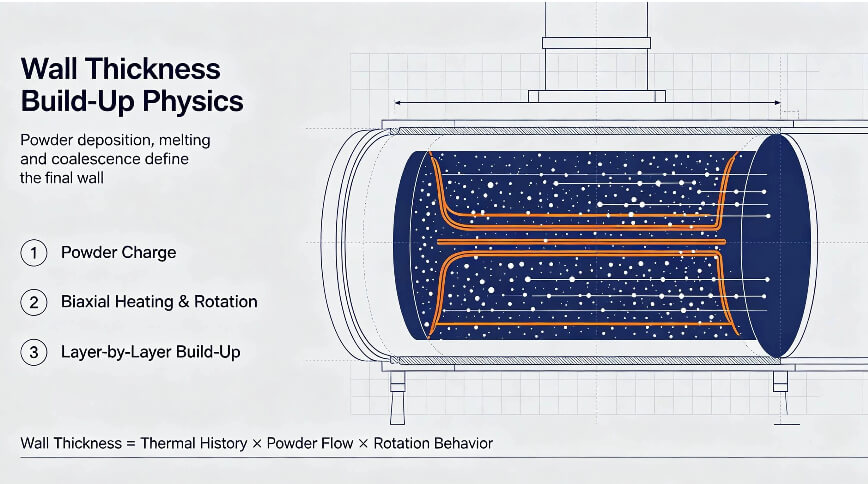
In rotomolding, a precisely measured amount of polymer powder is charged into a mold. The mold then rotates biaxially inside an oven. As it heats, powder particles adhere to the inner surface, melt, and coalesce. More powder continues to deposit until the material is exhausted or the cycle ends. Wall thickness is therefore not determined by a machined cavity; it emerges from a thermal and kinetic process.
 |
Why Uniform Walls Are Difficult to Achieve?
Several factors work against uniformity:
The Hidden Costs of Inconsistent Thickness
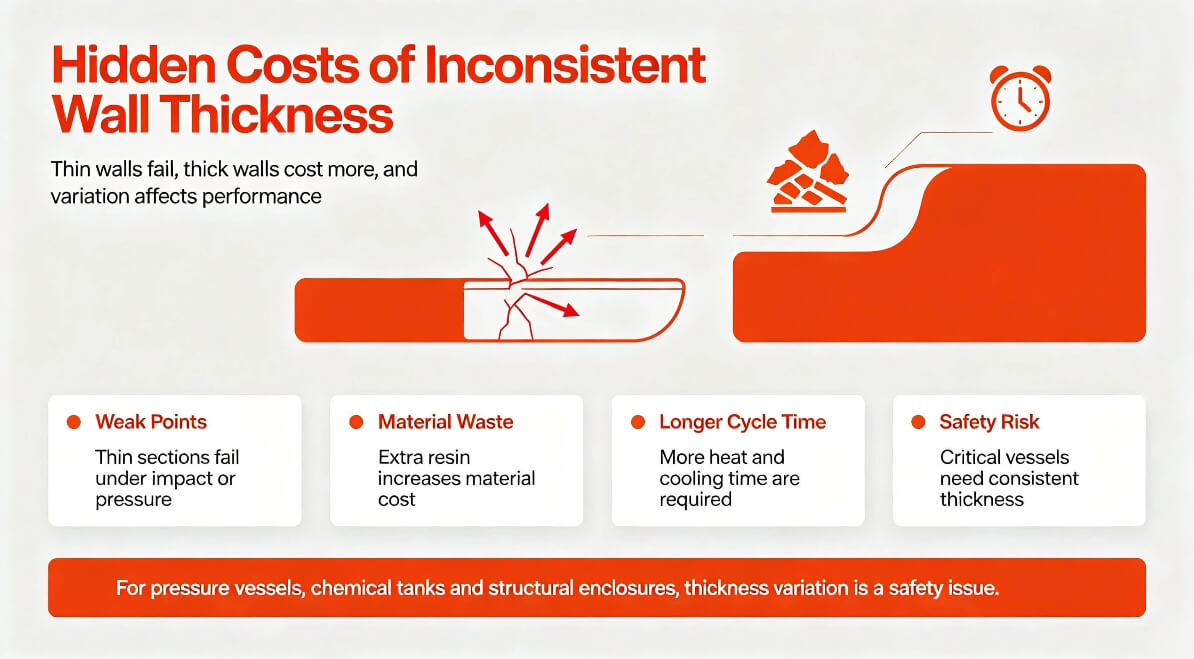
Thin sections become weak points under impact or pressure. Thick sections waste material and lengthen cycle time. Inconsistent walls can also lead to warpage, poor surface finish, and failure in leak or burst tests. For pressure vessels, chemical tanks, and structural enclosures, thickness variation is not merely a quality issue—it is a safety issue.
 |
What’s Changing in the Industry
New tools are making wall thickness control increasingly scientific. Thermal sensors and data logging offer real-time insight into internal air temperature. Simulation software helps predict powder flow and melting behavior before a mold is cut. Electric oven technology provides more precise temperature control and lower energy consumption. Automated powder dosing reduces human variation. Together, these advances are moving rotomolding from an experience-driven craft toward a data-driven process.
 |
 |
 |
 |
 |
 |
Frequently Asked Questions (FAQ)
Q1: What is a realistic wall thickness tolerance for rotomolded parts?
A: Typical rotomolded parts can hold nominal wall thickness within ±10% to ±20%, but local variation can be higher at corners and ribs. For critical applications, tolerances should be specified based on functional requirements and validated by sampling.
Q2: How is wall thickness measured on a rotomolded part?
A: Common methods include ultrasonic thickness gauging, destructive sectioning, and coordinate measuring machines (CMM). Ultrasonic gauging is non-destructive and suitable for production checks, while sectioning provides the most accurate picture of distribution.
Q3: How does the rotation ratio affect wall thickness?
A: The ratio of arm speeds determines how powder travels inside the mold. An improper ratio can cause powder to accumulate in one area and starve another, leading to thick and thin zones. Ratio optimization is part of process development.
Q4: What wall thickness is recommended for structural rotomolded parts?
A: For polyethylene, a minimum of about 3 mm is typical for structural integrity. Most industrial parts run 3–6 mm nominal. Thicker walls increase stiffness but also cycle time and material cost.
Scan to WhatsApp :

Home
products
contact