

Selecting the proper polymer forming process constitutes a core early-stage engineering decision for OEM designers and procurement teams. Misalignment between process selection and functional requirements can result in excessive tooling expenditure, dimensional non-conformity, or compromised long-term service performance of plastic parts (Kalpakjian & Schmid, 2020). Three dominant thermoplastic manufacturing routes — rotational molding, blow molding and injection molding — each operate under distinct pressure-temperature regimes, which define their geometric envelope, material constraints and economic production window.

Rotational Molding (Rotomolding / Rotomoulding)
Rotational molding is a zero-pressure hollow forming technique. Finely milled polymer powder is loaded into a closed mold; the mold rotates biaxially while heated inside an oven. Powder gradually melts and adheres uniformly to the mold interior surface, before controlled cooling consolidates the finished hollow component (Crawford & Kearns, 2022). Key engineering merits derive from its ambient-pressure forming condition. The process enables seamless large-scale hollow structures, supports molded-in metal inserts, and delivers inherently consistent wall thickness without heavy clamping force. The primary limitation lies in lengthy thermal cycle times, restricting the technology to low-to-medium production volumes. Typical engineered applications include large HDPE storage tanks, floating pontoons, custom fuel tanks and oversized containment vessels ranging from 50 L up to 50,000 L.
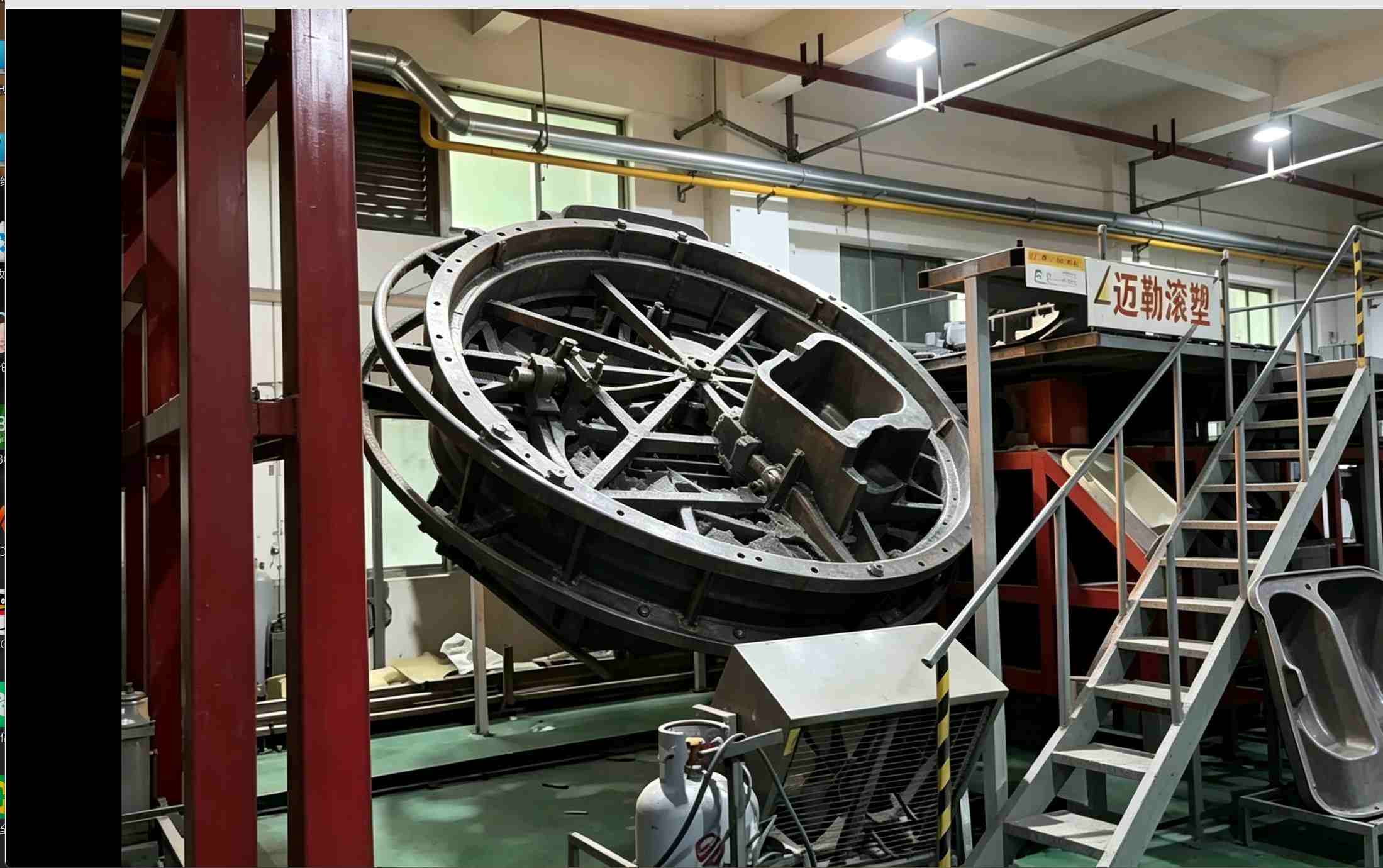
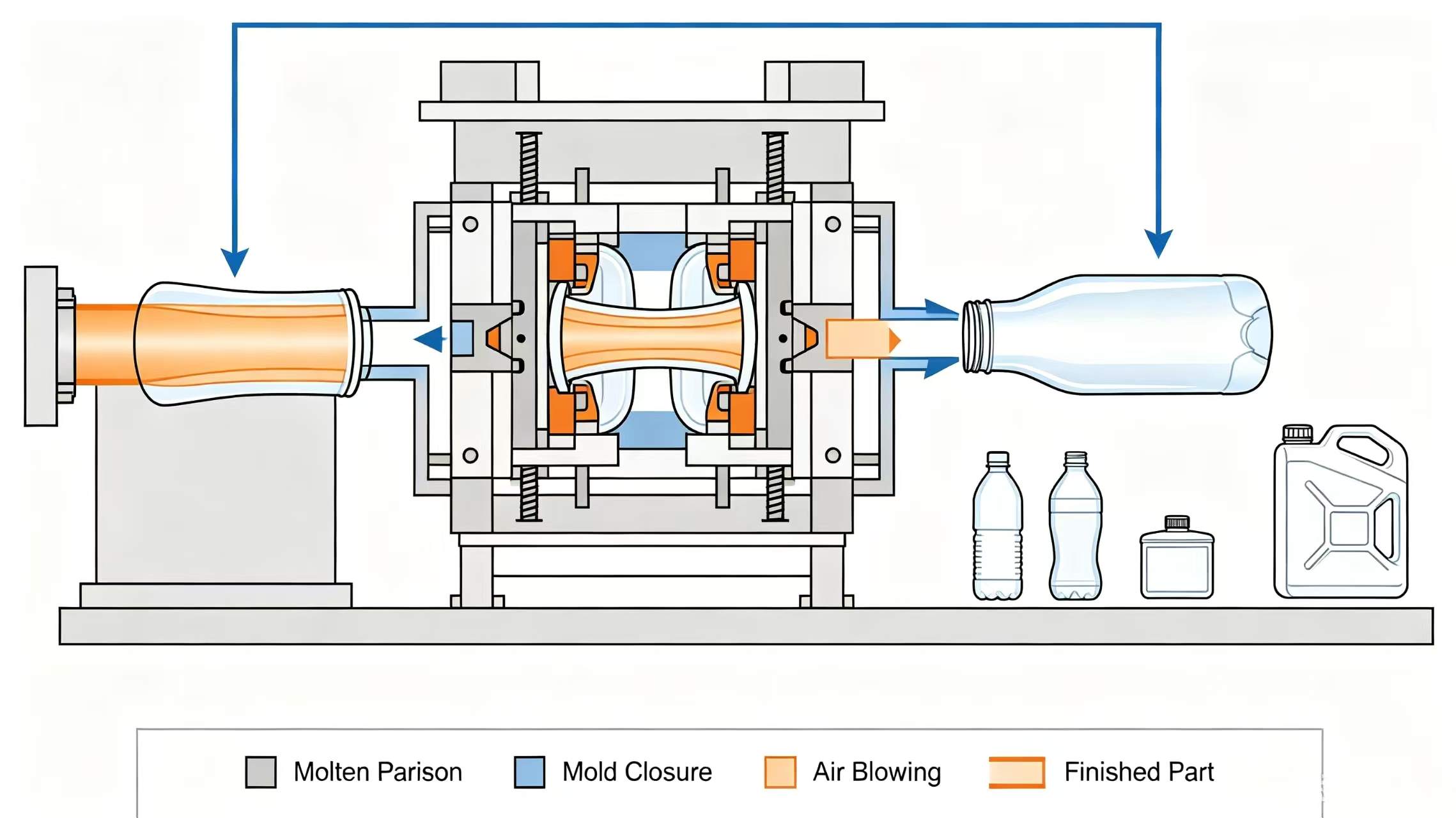
Blow Molding
Blow molding fabricates hollow thermoplastic articles by pneumatic expansion of a molten polymer parison inside a matched mold cavity. Compressed air inflates the parison, forcing material to conform against the mold interior. The process operates at moderate pressure between 50–140 psi (NPTEL, 2025). The principal advantage is high cycle throughput, which drives low unit cost for mass serial production. However, the process creates a permanent weld pinch line at mold parting planes, imposes geometric restrictions, and exhibits less consistent wall distribution in complex contours. Standard use cases cover medium-small thin-wall hollow packaging: bottles, jerrycans and simple fluid containers.
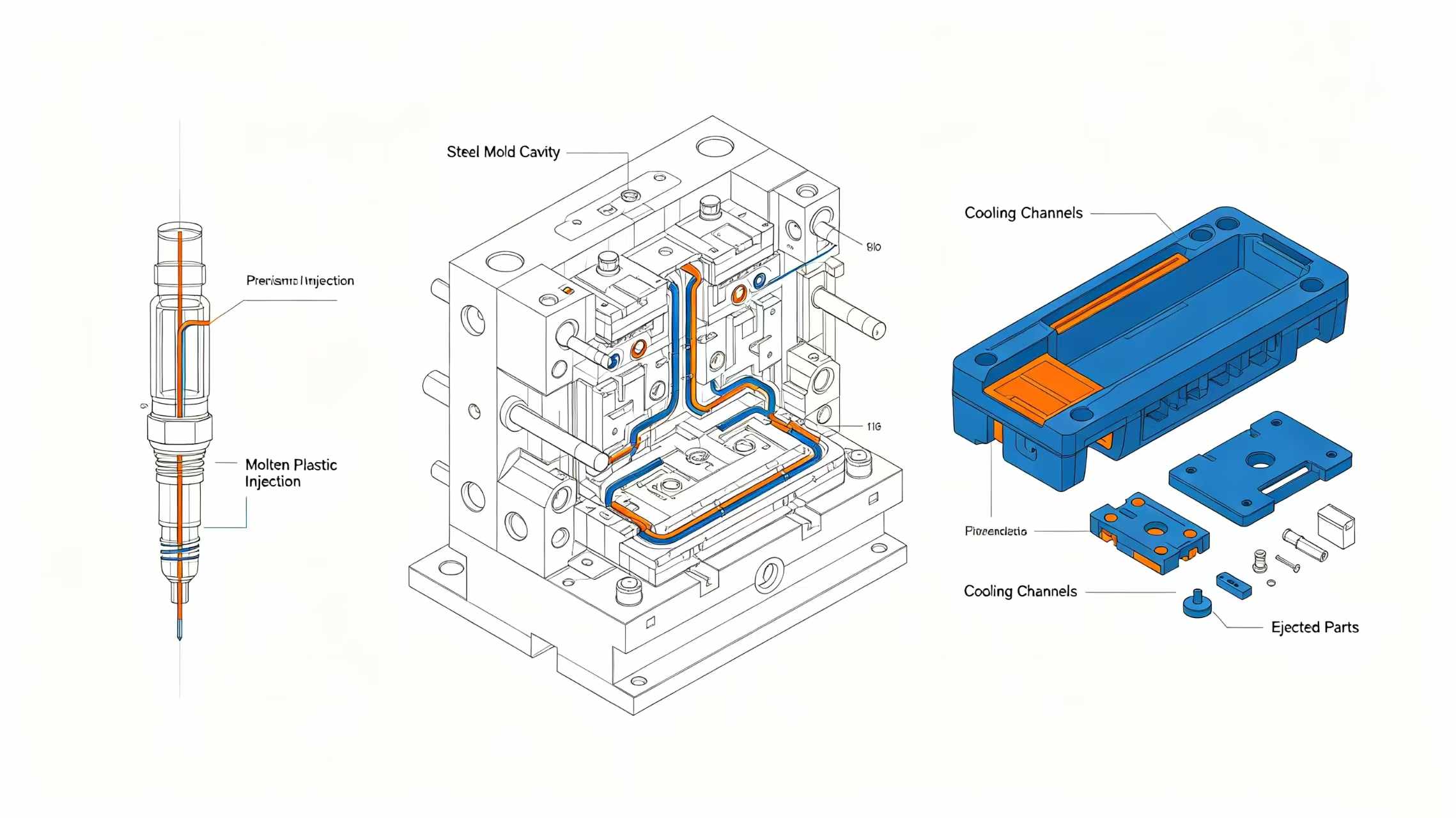
Injection Molding
Injection molding forces molten thermoplastic pellets under high hydraulic pressure into precision-machined closed steel mold cavities. After cooling and solidification, the mold opens to eject discrete solid or semi-hollow parts. This high-pressure process delivers tight dimensional tolerances and excellent replication of fine surface features (Kalpakjian & Schmid, 2020). High-hardness tooling enables millions of production cycles, yet tool capital expenditure is substantial, and mold revision costs are high. The process is economically optimized for high-volume production runs and is not suitable for extra-large hollow components. Common products are precision solid plastic components, structural housings and small assembly fittings.
Comparative Engineering Matrix
| Parameter | Rotational Molding | Blow Molding | Injection Molding |
| Maximum part scale | Large to extra-large | Small and medium | Small components |
| Operating pressure | Ambient / 0 psi | 50–140 psi | High hydraulic pressure |
| Tooling investment | Low | Medium | High |
| Economic batch range | Low ~ medium volume | Medium ~ high volume | High volume |
| Wall thickness uniformity | Excellent | Moderate | Good |
| Seamless construction | Fully seamless | Contains pinch weld line | No continuous hollow shell |
| Typical dimensional tolerance | ±2% | ±0.5–1% | ±0.05–0.3% |
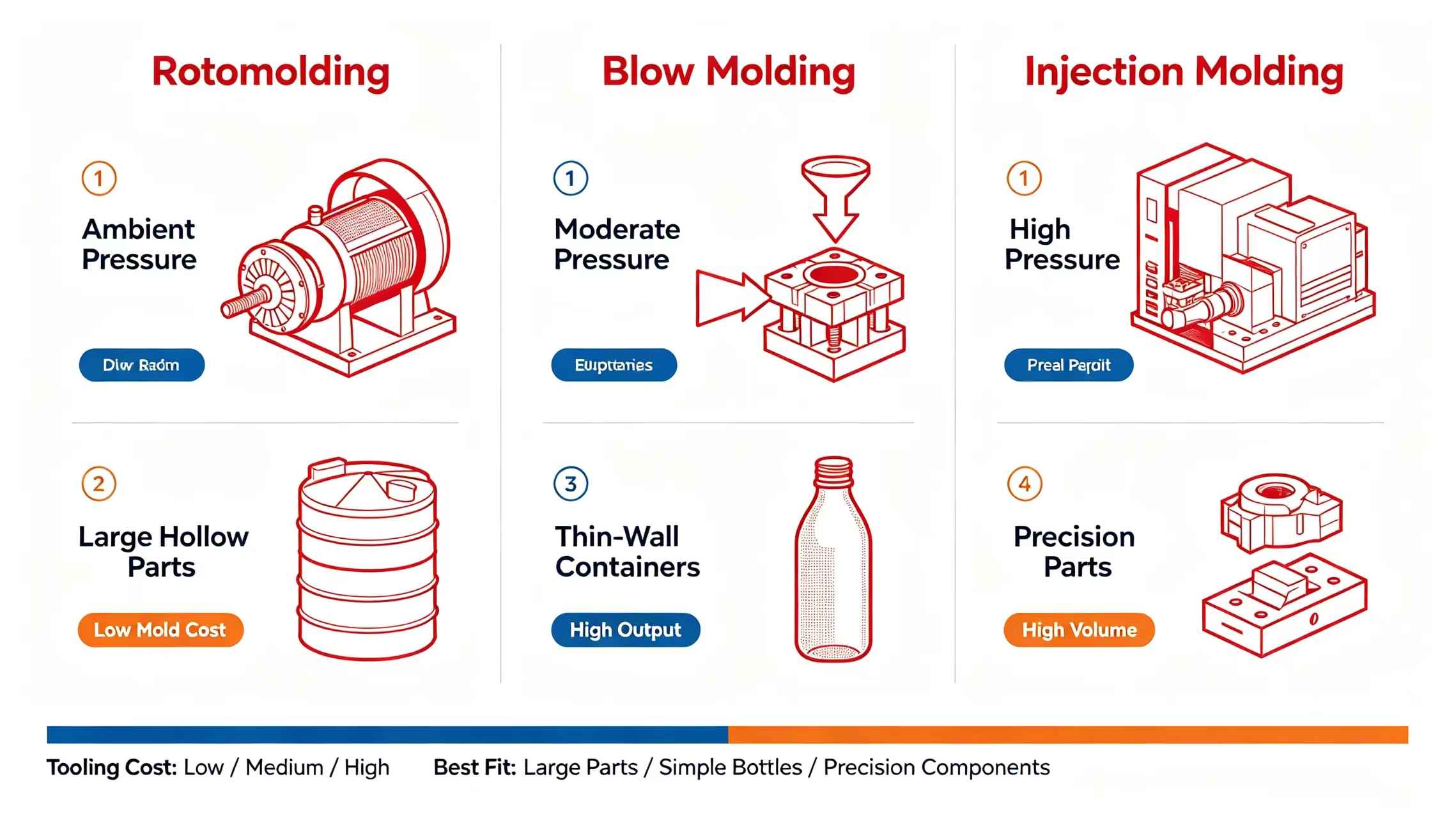
Engineering Decision Framework
Partner with Mellow Rotomolding
Mellow Rotomolding delivers custom rotational molded components including plastic storage tanks, floating pontoons, OEM fuel tanks and structural housings. Our engineering team reviews part geometry, material specification, load requirements and batch volume to validate process feasibility. Submit CAD drawings or technical specifications to receive a detailed engineering assessment and formal quotation.
References
Scan to WhatsApp :

Home
products
contact